By Alireza Nurbakhsh
Do not say the Beloved has left
And the City of love is empty.
The world is full of perfect masters,
But where are the sincere disciples?
I have always wondered what makes certain people have such a strong belief in a spiritual path and master, the kind of unshakable belief we have, for example, in the rising of the sun each morning. There are, it seems to me, two kinds of people who have such strong religious beliefs. One sort, very common in this day and age, are totally dogmatic about they believe to the extent that they find it their duty to impose their beliefs on others, sometimes even through force. Such people are fanatics and nothing of interest can be said about them.
There are, on the other hand, others who do not talk much, who have no interest in converting us to what they believe. Try as one may, one cannot figure quite figure out what their beliefs really are. They are, so to speak, true mystics, and they approach spirituality from a completely different angle, being the very embodiment of spirituality, full of deeds with few words. They speak to us through their actions with little concern about whether we believe in them or not. In short, they go ahead leading a spiritual life while the rest of us spend out time worrying about what spirituality is.
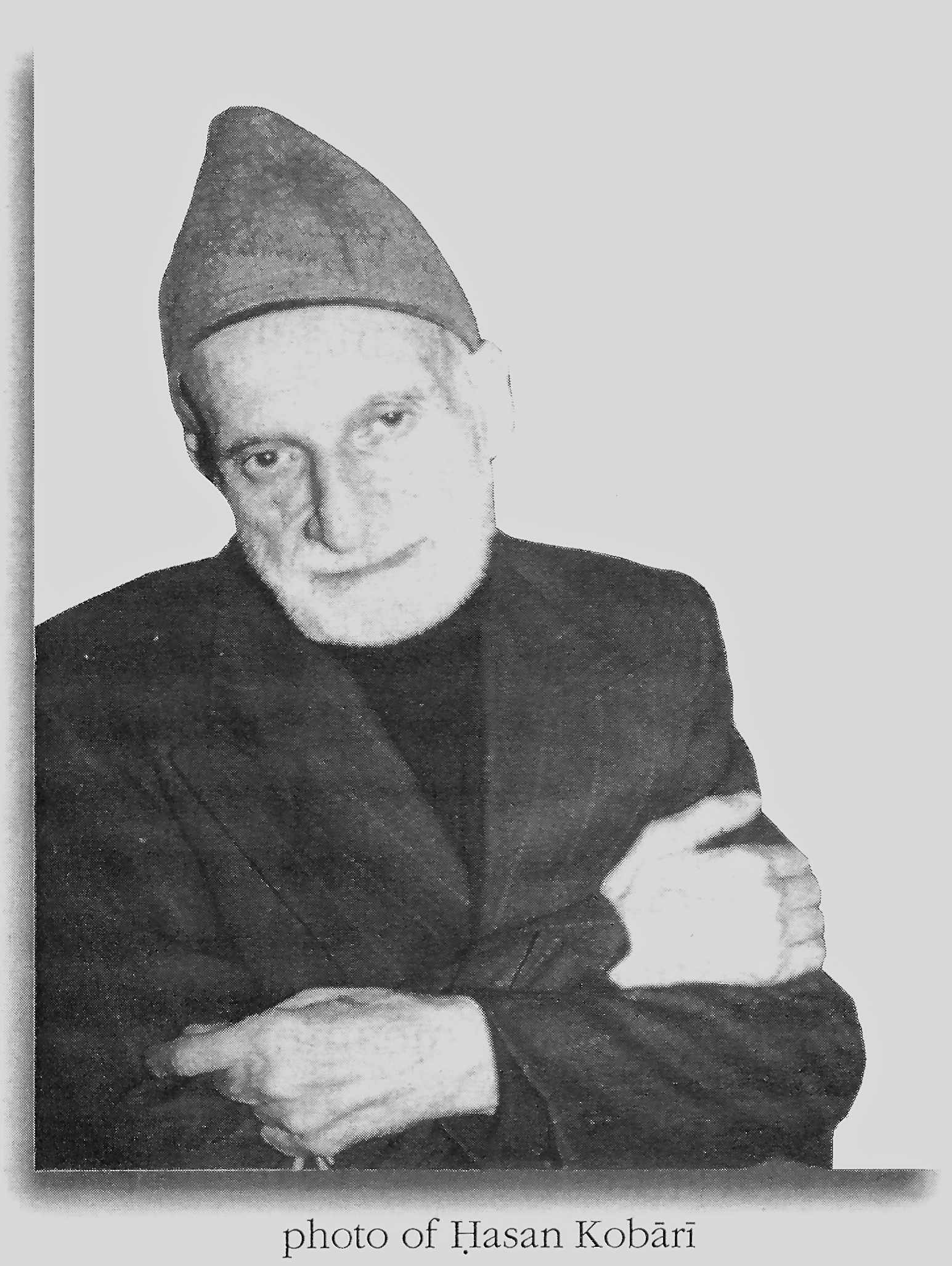
Hasan Kobari was such a person.
Raised in the province of Gilan at the edge of the Caspian Sea, Mr. Kobari was already a middle-aged man when he first came to the Nimatullahi khanaqah in Tehran. For thirty years he had devoted himself to government work, and he was at the time of his arrival at the khanaqah a high-ranking official in the Ministry of Finance with great power and prestige. However, after his initiation into the Sufi Path by Dr. Nurbakhsh, a young shaykh at the time, he resigned his government post and gave up all that he had achieved in the world to devote himself whole heartedly to the Path of Love.
Mr. Kobari hardly ever talked about Sufism; rather, he lived the life of a Sufi. If you were to push him, you might get a few words about Sufism, but even that was rare. You had to work very hard indeed to show him that you needed his advice for practical purposes before he would speak. I remember someone once asked him about the spiritual significance of a dream he’d had. Mr. Kobari responded by apologizing for not knowing anything about the meaning of dreams, telling the man that what mattered was not understanding one’s dreams but accepting them, like everything else, as Godsent and continually remembering Him. And then he asked the man to run an errand for the khanaqah, saying this was far more useful.
To the western mind, this approach to spirituality will surely sound strange. One would think that spiritual matters must be understood at some level first before putting them into practice. If I don’t know, for example, them meaning and the significance of dhikr (remembrance), how can I go about practicing it? Mr. Kobari’s approach was that the understanding comes later – after one practices what one is supposed to practice and does what one is supposed to do. For him, a spiritual life was a life of selfless deeds, and understanding the meaning and value of such deeds took place only after one became totally immersed in them. I can recall him saying once that to truly understand what pain is, one has to feel it, experience it, and that reading various theories about pain, though interesting, would never enable one to understand it fully.
* * *
I first met Mr. Kobari when I was quite young and, naturally, very naive. Nevertheless, he accepted me with openness and respect, the way he accepted everyone. He never acted spiritually superior, despite his many years as a darvish, and always treated me as an equal. As a result, I felt quite at ease around him and began to follow him around throughout much of the day.
Since there was always something to do around the khanaqah, he allowed me to help him with various chores, such as watering the plants, serving tea, or getting the books issued by the khanaqah ready for publication. He firmly believed that the various jobs around the khanaqah had to be done in the most economical and hardest way possible. At one point I became tired of using a small pot for watering the many plants around the khanaqah and instead decided to water using a hose. As soon as Mr. Kobari saw me with the hose, he reproached me for being lazy, telling me that I was wasting water and had taken the easy way out. He went on to explain that work around the khanaqah was there to discipline one’s nafs (ego), and that one’s nafs always wanted to take the easiest way out. At the time, his admonition didn’t make much sense to me. In my naivete, I thought, surely, the important thing was to get the job done, not how you did it. Only years later did I finally come to see the truth of his words.
Mr. Kobari constantly struggled against his nafs, against his worldly desires, to the extent that at times I wondered whether he had any sense of self at all. Even a single negative thought was enough to make him take drastic measures to correct himself. Once, in the presence of twenty or so darvishes, we were proofreading a book against the Arabic manuscript. Since he knew Arabic well, he was reading the Arabic text out loud from the manuscript while I had to see if the printed version corresponded with it.
We were in the middle of this work when the doorbell rang and a mullah who had an appointment to see the master arrived and sat with us waiting for him. The minute the mullah sat down, he asked for tea and began to preach to everyone. Mr. Kobari listened to him for a few minutes and then turned to me and said that we should continue our work. To my total astonishment, he began to recite the Arabic incorrectly, especially the Koranic verses. As soon as the mullah heard Mr. Kobari’s incorrect recitation of the Koran, he began to correct him.
For the next half an hour, the mullah constantly corrected Mr. Kobari in a very rude and obnoxious way. Each time he did so, Mr. Kobari would apologize, asking the mullah for forgiveness. After what seemed like hours, the mullah was finally summoned to see the master. As he was leaving the room, he ordered Mr. Kobari to stop reading altogether, reminding him that it was blasphemy to recite Koranic verses incorrectly.
During this episode, I had been forced to exert great restraint to keep myself from insulting or cursing out the mullah. I was also totally confused by Mr. Kobari’s actions. When I finally found him alone later that day, I asked him about the meaning of his behavior with the mullah and why he had purposely mispronounced the Arabic so badly. “The moment I saw the mullah,” he replied, “the thought entered my mind that I was better than him. So shamed did I feel by this thought that I had to make amends to the mullah and seek forgiveness for my arrogance and sense of superiority.”
Although he had the means to maintain a very comfortable lifestyle, Mr. Kobari instead lived a simple life. He devoted half of his retirement pension to the everyday necessities of the khanaqah and the other half to his family, which consisted of his wife and an old servant whom he treated like a sister. His home contained but two rooms, a small kitchen, and a garden. In the mornings he would travel around Tehran, running various errands for the khanaqah: making sure the printers were doing their job, buying groceries, going to the bank, and performing numerous other services that were essential for the everyday running of the khanaqah. In doing so, he always attempted to be as frugal as possible. As an example, he avoided taking public transportation as much as possible, traveling on foot except when this was impossible and then taking the bus rather than a taxi, with no thought of the hardship it involved.
Being with Mr. Kobari, everything became a learning experience. One day I received permission to accompany him on an important errand. Given his predilection for avoiding public transportation, I prepared myself for a very long walk. To my surprise, however, he insisted on taking a taxi that day since I was his guest. Noticing my confusion and disappointment, he added: “Sufism is a lack of attachment to anything, even refusing to take a taxi can become an attachment.”
After performing his daily chores, Mr. Kobari would go home each day to have lunch with his wife. Though he rarely invited anyone to his home, he always welcomed those who showed up, and people were always going to his home uninvited in the hope of spending a few minutes with him. I myself often had the honor of going to his home for lunch. We would eat our lunch and then afterwards watch television for half an hour on a small black and white set that he had received as a present from his daughter.
Amazingly, even while watching television, Mr. Kobari couldn’t help but be overwhelmed by a sense of the Divine. One day, for example, we happened to be watching Gunsmoke. (Certain American shows were very popular on Iranian television at the time.) In this particular episode, one of the characters ended up sacrificing his life to save an individual he barely knew. Mr. Kobari was so overwhelmed by the episode that he began to sob very quietly and then, his whole being shaking, he turned to me and in a soft voice said, “This is love, yet I am still so far away from it.” With that, I too began to cry, being totally caught up in Mr. Kobari’s state. Later, after returning home, I realized that this was the difference between a man of God and the rest of us: he perceived Divine beauty where we see only garbage.
For twenty-five years, Mr. Kobari went to the Tehran khanaqah each day from two o’clock in the afternoon until ten o’clock at night, never leaving as long as anyone else was still there. He always took on the hardest and most menial jobs in the khanaqah, setting an example for all the darvishes. During the meeting nights, even though he had given years of service to the khanaqah and earned the highest place of honor, he continued to sit in the entrance room the darvishes would leave their shoes.
The tearoom of the khanaqah where Mr. Kobari always sat and worked during the day became a kind of training school for the darvishes, at least for those darvishes with the awareness to understand what was going on. He would teach by example, offering his services sincerely to all who needed them without ever being asked or expecting anything in return. Though he was in charge of all the khanaqah business, I never heard him order anyone directly. Rather, he would let the darvishes know what needed to be done, what was correct, by his actions, by always being the first to undertake any work, starting the most arduous and unpleasant tasks himself, but never with any trace of pride or self-satisfaction.
At the same time, no task was too small for him if service to another darvish was involved, whoever the darvish and whatever the circumstances. One time, a newly initiated darvish was sitting in the gathering on one of the meeting nights. Mr. Kobari happened to pass by and the darvish, not knowing any better, asked him for tea. A number of darvishes immediately tried to get up to go for the tea in Mr. Kobari’s place, but he told all of them to sit and went for the tea for the newcomer himself.
From the moment Mr. Kobari arrived at the khanaqah until the moment he left, he was constantly busy due to his devotion to the master and the other darvishes, whose well-being he consistently put above his own. The following story, told to me by one of the older darvishes, illustrates this well. This darvish was once staying in the Tehran khanaqah during a particularly cold winter. One night, he saw Mr. Kobari leave the khanaqah at ten o’clock as usual. About two hours later, the darvish still lay awake, being unable to sleep. Suddenly, to his surprise, he noticed Mr. Kobari slipping back into the khanaqah. Puzzled, he watched to see what he was up to. After opening a closet, Mr. Kobari took out a can of kerosene and proceeded to fill the heater in the room where the darvishes slept. Then he departed as silently as he had arrived.
The next day, the darvish asked Mr. Kobari about the previous night. He hesitated for a moment, then explained that after getting home and going to bed, the thought entered his mind that the kerosene heater might be running out of fuel in the room where the darvishes were sleeping and he was afraid it might become too cold and disturb them. As a result, he had gotten up and in the dead of the cold winter night walked all the way back to the khanaqah to make sure that the darvishes would be warm enough. Of course, if it hadn’t been for the darvish seeing him that night, no one would ever have known of this act of selfless kindness. Indeed, who knows how many other times Mr. Kobari performed such acts? They were his life.
Everyone who came in contact with Mr. Kobari, including those who never knew him as a Sufi, could not help but be affected by him in some profound way. He treated everyone with great respect while at the same time managing to be very direct. On one of our many trips together, I accompanied him to the printers where we had to see the man who was in charge of the binding department. He was a middle-aged man who was very fond of Mr. Kobari and who always charged him a fair price for the binding of books.
As usual, Mr. Kobari was very courteous to the man. When we sat down to discuss the cost of the binding for the forthcoming book, he suddenly turned to Mr. Kobari and said, “Please, can this matter wait? I want to ask your opinion concerning a much more serious matter.” He then went on to tell Mr. Kobari that he had decided to become a Sufi and would appreciate it if Mr. Kobari would ask the master about the possibility of him being initiated.
Without hesitation, Mr. Kobari shook his head and told the binder that Sufism was not good for him. Dumbfounded since he knew Mr. Kobari’s devotion to Sufism, the man then asked him how this could be so. “Because,” Mr. Kobari answered, “if you become a Sufi, you will no longer be able to charge us for the binding of our books. Do you think you can give up this money?”
The man lowered his head and fell silent for a long time. Finally, Mr. Kobari broke the silence, saying to him, “If you really want to know the truth, I’ve come to the conclusion that everybody is a Sufi in his or her own way without realizing it. Now let’s talk about the cost of the binding for the book since this matter is much more urgent.” After Mr. Kobari’s death, the binder came to accept the condition he had set down and was initiated into the Path.
Towards the end of his life, Mr. Kobari grew so physically weak that he could barely manage to commute from his home to the khanaqah. Thus, one day the master asked him to move into the khanaqah. Mr. Kobari was overjoyed at the master’s invitation, for moving into the khanaqah had always been his dream. More than once he had told me that the only thing he still wanted from God was to be able to live and die in the khanaqah among the darvishes and near the master.
Needless to say, he was very excited at first about living in the khanaqah. After twenty-five years of going to the khanaqah, he was at last going to be able to live in the place about which he cared so much. Soon, though, he realized it was much easier to commute to the khanaqah each day than to live in it. Living in the khanaqah, he was constantly concerned, sometimes to the point of being obsessed, with the well-being of the darvishes and the state of the khanaqah. Once he moved into the khanaqah, he found that he couldn’t sleep anymore, always feeling obligated to check and double-check everything, such that he soon grew very ill. Eventually the situation became so bad that he asked the master for permission to go home and die in peace. And that is what he did.
On March 23, 1978, a few weeks after returning home, Mr. Kobari died peacefully in bed. Perhaps the most fitting epitaph for him is the description of the disciple provided in The Path by Dr. Nurbakhsh, the master to whom he was so devoted:
The disciple is a sincere seeker who is freed from all attachments. The disciple longs for God as he or she passes from ‘self’ and takes to the Path not speaking of self. Such a one has no tale to tell about his or her ‘I’ and can never complain about the Beloved.
The disciple is a lover whose heart is languishing and weary. He or she is one who has passed beyond both worlds and become united with the Truth. Such a one seeks God alone, and in his or her words there is only talk of God. The disciple approaches the Beloved and is ensnared by Love. Moment to moment, he or she continually purifies the mirror of the heart from the tarnish of ‘self’, and through the grace of God it shines brilliantly with His light.
This article originally appeared in Sufi Journal, Issue 17, Spring 1993.
 michigansufi.com
You must be logged in to post a comment.