by Terry Graham
“My life can be summed up in three statements:
I was raw; I was cooked; I was consumed.”
– Rumi
Where the lives of some masters are studied simply for their teachings, few of the great guides of the Path have left lives so documented that one can trace the individual’s spiritual progress to perfection step by step as Rumi, the chroniclers of whose life have provided us with so palpable an example of how one may proceed. Not only do we have the accounts of contemporaries, or near-contemporaries, like Sepahsalar, Aflaki and Rumi’s own son Soltan Walad, but we even have the vivid experiential descriptions given by both Rumi and his key guide, Shams-e Tabrizi, to give us an insight into his biography.
Rumi’s life may be conveniently divided into five parts, each marked by an association with a figure who was more important to him at the given time than anyone else. The first such person was his father, Baha’o’d-Din Walad; the second, his master in the classical sense of initiator and trainer, Borhano’d-Din Mohaqqeq; the third and most famous, the catalyst of the process of his spiritual realization, Shams of Tabriz; the fourth, the re-solver of his experience with Shams, so that the forces unleashed in the course of his attainment could coalesce, the humble goldsmith, Salaho’d-Din Zarkub; and finally, the fifth, the young companion to whom he addressed his epic work, the Mathnawi, his favored shaikh and designated Successor, Hosamo’d-Din Chalabi.
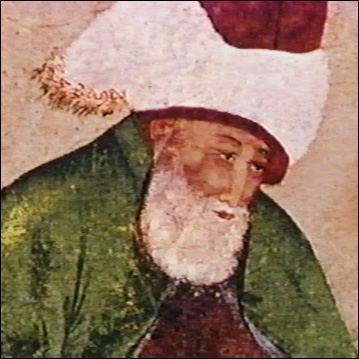
Mawlana (the Arabic honorific title meaning ‘Our Master’, by which he is affectionately remembered by Persian and Turkish Sufis) Jalalo’d-Din Mohammad Rumi1 or Balkhi2, was born on 30 September 1207 in a city with ancient antecedents. Founded by Alexander the Great, Baikh served, upon the dissolution of the conqueror’s empire, as the capital of the Graeco-Bactrian kingdom, surviving in the region after other Greek dominions had been retaken by Iranian peoples. When the city was eventually reclaimed by the natives of the district, it was converted to Buddhism, the religion which dominated the area of what constitutes Afghanistan today, ruled in the early centuries A.D. by the Iranian Kushans, a Buddhist dynasty based in Kabul.
With the Islamic conquest in the seventh century, the mystical tradition of the Buddhist legacy merged into both the popular culture and the Sufism of the region, as the tale of Ebrahim ebn Adham (d. 778) indicates, where this Sufi of the first generation after the Prophet was recounted to be, like the Buddha, a prince who abandoned his wealth and power to travel a path of asceticism, and where a later wali of the area, Emam Redha’, became known as the ‘Protector of the Gazelle’, with the legend of the Buddha’s saving of a deer from a hunter’s arrow came to be ascribed to him. Further more, the descendants of the line of Barmak, the priestly maintainers of the principal pagoda of the town, Nowba-kht Bahar, on being converted to Islam, became ministers to wield a weighty influence in the Persianized Abbasid caliphate in Baghdad, bringing sympathy for both Persian culture and mystical sensibility to the court of the most powerful government in the Islamic world during the eighth-through-thirteenth centuries, the age of the formation of both Islamic culture and Sufism.
Rumi’s father, Baha’o’d-Din Mohammad Walad ebn Hosayn Khati-bi Balkhi (d. 1231), was acclaimed the most prestigious of the theologians of the city, the soltano’l-‘olema’ (‘king of scholars’). At the same time, his professional distinction was enhanced by his apparent position as a shaikh of Najmo’d-Din Kobra (d. 1220), founder of the Kobrawiya Order, whose center was near Khiva, the capital of the Khwarazmshahs, the rulers who captured Baikh a year before Rumi’s birth and made it the southernmost part of their domain.
When, as the result of a provocative act on the part of the Khwa-razmshah, the Mongols invaded the kingdom of Khwarazm, Baha’o’d-Din gathered his family together and set out for Mecca, pressing ahead of the Mongol advance. Stopping at the Khorasanian metropolis of Nishapur on the way, he visited the great Sufi shaikh and poet, Farido’d-Din ‘Attar (d. 1221), to whom he presented his son, now aged 13. The poet presented the lad a copy of his mystical epic in rhyming couplets (mathnawi), the Asrdr-nama (‘Book of Mysteries’) and told the father, ‘Make haste’. This boy of yours is going to set the consumed of the world on fire!” (Dowlatshah 1901, p. 193)
Once the family had performed the rites of the holy places, in the Hijaz, Baha’o’d-Din decided to head northward for the great cities of Syria, cultural centers far from the Mongol fury, as his hometown was being ravaged and razed to the ground. Stopping briefly in Damascus and Aleppo, he was invited to take a position of theological instruction in the town of Laranda (present-day Karaman in Turkey), taking him over the Taurus Mountains to the Seljuq Turkish sultanate of Rum. The year was 1225 and Rumi, not yet 18, was married to Gawhar Khatun, the daughter of Khwaja Lala Samarqandi. There was born Rumi’s most distinguished son, Soltan Walad, shaikh and prolific author, and ultimately successor to Hosamo’d-Din Chalabi in the Maw-lawi initiatic chain, as well as being perhaps the most important source of intimate material on his father’s life.
The distinction of the scholar and mystic, Baha’o’d-Din Walad, came to be known to the enlightened ruler of the sultanate, ‘Ala’o’d-Din Kayqobad (r. 1219-38) and his equally inspired minister, Mo’ino’d-Din Parwana (d. 1276), a Persian from the region of Daylam on Iran’s Caspian Sea coast. He was invited to reside in the capital, Konya, which was becoming a center for refugees from Khorasan and Tran-soxiana, like Najmo’d-Din Razi, author of the Mersdd al- ‘ebdd, the Sufi’s handbook of the day, as well as prominent figures from other regions, such as Fakhro’d-Din ‘Eraqi, the poet and master, who, like Baha’o’d-Din, had traveled up from the Hijaz, though he had settled for a time in Egypt before proceeding to Syria and Anatolia.
Indeed, there was a vital connection between Konya and the two great cities of Syria, as the relationship between the gnostic theosopher Mohye’d-Din ebn ‘Arabi and his son-in-law and prime expounder of his school in Persian, Sadro’d-Din of Konya, a future friend of Rumi, was to indicate. Rumi himself was to maintain a constant association with Damascus and Aleppo, where he pursued advanced studies and came to know such Sufi luminaries as the Kobrawi master Sa’do’d-Din Hamuya, author of important texts, the Persian poet Awhado’d-Din Kermani and the theosopher Qotbo’d-Din Shirazi. It was in 1228 that Baha’o’d-Din settled with his family in Konya, and Rumi, now 21, was to spend the rest of his life there. When his father died three years later, he succeeded him as the leading theologian of the capital at the youthful age of 24, already a personage of considerable weight and prestige. In fact, his importance as an issuer of judicial decisions (fatwd) was such that he is cited as an establisher of legal precedent in the law books of the Sunni Hanafi school of Islam. As with the majority of Persian Sufis of the day, he was associated with the Ash’arite school of theology.
Rumi’s authority was not only in the exoteric law, but also in the mystical theology in which his father had brought him up, the principles of which are expounded in Baha’o’d-Din ‘s book Ma ‘aref (‘Gnostic Cognitions’), a field in which Rumi was to prove his own expertise in his philosophical work, Fihe mafihe. All of this was testimony to Rumi’s monumental intellect. However, his era of pre-eminence in matters of the law, the shari’at, and of theology through the intellect alone was about to be expanded into the manifold realms of higher consciousness, for soon a former disciple of his father in Baikh was to appear on the scene. The year was 1231. The first period of Rumi’s life, that of guidance by his father, had come to an end, and the second, that of discipleship to Borhano’d-Din Mohaqqeq Termedhi (d. 1240), was to begin.
Borhano’d-Din had traveled south from his native Termedh to Baikh to be initiated by Baha’o’d-Din. When the latter left on his journey west, he returned home briefly. Then he joined the exodus from the Mongol depredations. By the time he arrived in Konya, he was already a master in his own right and able to initiate his master’s son and to undertake the work of guiding him to the end of the Sufi Path. Rumi’s initiation by Borhano’d-Din also marked the beginning of his departure from the stage of ‘being raw’ and introduction to the process of becoming ‘cooked’.
Having mastered all that the traditional educational system had to offer, and reached the heights of professional attainment that most men of his day aspired to by middle age, Rumi was now ready to turn to the inward quest in earnest. Borhano’d-Din reinforced his father’s teachings and committed him to a regime of work on himself (mojahadat) and ascetic discipline (riyadhat), including a series of chellas (‘forty-day retreats’), with austere exercises and constant recitations of litanies (awrad) which he prescribed. This period lasted eight years. When Borhano’d-Din completed his work of bringing Rumi to perfection, making him ‘cooked’, he proceeded to appoint his successor, Salaho’d-Din Zarkub, a goldsmith in Konya bazaar, then he left Konya, going eastward to Kaiseri, where he died, the year being 1240.
Rumi’s experience with Borhano’d-Din and his feeling for this master who brought him to the end of the Path is reflected in the advice he was later to give to Sufis in the Mathnawi:
Become cooked
and transcend fluctuation;
Go become light,
like Borhan Mohaqqeq.
When you’re released from self,
you’ve truly become
Borhan3,
For in declaring yourself
a slave, you become a king.
(Rumi, 1975, II 1319-20)
The second period of Rumi’s life did not end with his master’s death. Where he might have gone naturally to Zarkub as his master at this point, a cataclysmic event occurred to him, directing him to another master. Although he was to carry on for another four years following the spiritual teachings bequeathed to him by Borhano’d-Din, all this was to be shattered in October of 1244, when the most influential figure in his life arrived in Konya. This personage was Shamso’d-Din Mohammad ebn ‘Ali ebn Malek-dad Tabrizi. As Aflaki recounts the background of Shams’ arrival:
At the beginning of the Path, he had become a disciple of Shaykh Abu Bakr Tabrizi the Basket-weaver (sella-baf); at the end, having completed his traversal of the Path (sayr-o soluk) and realized perfections and states beyond the perception of those who truly perceive, he set out in search of a most perfected one who was of the highest of the perfect masters capable of bringing others to perfection (afdhal-e mokammalan-e mo-kammel). (Aflaki 1983, p. 615)
Before Rumi arrived. Shams had turned down applicants of stature such as Awhado’d-Din Kermani, whom he told, “You don’t have the capacity to follow me.” When the latter insisted that he did. Shams challenged him to drink wine with him in public in the busiest part of town, then to bring him the finest wine available, then at least to sit with him while he drank wine. When Awhad confessed that he was incapable of acceding to each of these behests in turn. Shams bellowed in his face:
Stay clear of the men!… Accept the fact that you do not have the necessary capacity, that you lack the strength of God’s elect. So, you are not cut out for discipleship to me. You are not up to it. You must be ready to trade all the desires of the world for a cup of wine, and this is the work of the men of the field, the work of one who would have known that I am not looking for just any old disciple. I accept only a master, and not just any master, but a realized perfect master. (Ibid.,, p. 617)
The circumstances of their meeting were almost casual. Though Shams had seen Rumi several years before in the bazaar of Damascus, the younger man was still engaged in his educational formation, so the time had not been ripe. Now, on the day at hand, Rumi was out riding with a group of leading scholars. Coming out of the courtyard of the college maintained by the Cotton Merchants’ Guild, they were proceeding past the Confectioners’ Caravanserai, when Shams, who had been sitting in front of the hostel, leapt up and seized the bridle of Rumi’s horse, crying, “0 leader of the Muslims! Was Bayazid greater or Mohammad?”
The question, which rift Rumi’s being like a bolt of lightning, was only the ostensible catalyst causing, as he later recounted, “the seven heavens to be sundered from one another and crash to the earth and a mighty fire to blaze up from my bowels to my brain, whence I saw smoke issuing up to the very Divine Throne” (ibid., p. 619). The substance of the question had less to do with the relative states of Bayazid and the Prophet than with the nature of Rumi as a Sufi proceeding beyond his former degree of realization. Shams’ answer was that Mohammad was greater because, where Bayazid was content with the cup of perfection, the Prophet constantly thirsted to penetrate the mysteries ever more deeply, but Shams was simply using their expressions—respectively, “Glory be to Me!” and “I have not known You as You deserved to be known”—as symbols illustrating the point he was making to Rumi and to all who had ears to hear, that they might understand the stature of the man whose further development he was taking in hand. He was, in effect, by implication associating Rumi with the likes of Bayazid and the Prophet. To demonstrate that by his example Shams was concerned with Rumi’s state rather than Bayazid’s, one need only look at a statement in another context indicating that Bayazid could be as insatiable as the Prophet when, rather than being surfeited like others, he cried the Koranic query: “Is there more?” (Koran L: 30)
As Shams himself described his relationship with Rumi in his Maqalat: (‘Discourses’): “I came to Mawlana. The first condition of this was that I did not come as a master. God has not brought onto the earth one who could be Mawlana’s master, and he could be no human being. Neither am I one who could be a disciple. I have passed that stage.” He went on to say that he had come primarily as a friend, to bring peace, to bring a resolution between the inward and the outward being. “Now I am Mawlana’s friend, and I know certainly that Mawlana is a wali (‘friend’) of God” (Shams 1990, vol. II, pp. 179-80).
Indeed, rather than being a master in the classical sense of a Borhan Mohaqqeq, Shams was more a catalyst releasing energies in an already perfected master. Up to then Rumi’s path had been a sober one, governed by reason; now it was to become awash with drunkenness, driven by love. Henceforth, the sedate professor and magistrate was to turn into a wayward-seeming drunken qalandar, violating every sort of convention, to the very depths of abject disgrace. As Rumi himself described his state in a quatrain addressed to Shams:
I was an ascetic;
you made me a lyricist,
you made me the life of
the party,
you made a wine-seeker.
You saw me sedate,
a pillar of the faith;
you made me the sport
of the neighborhood children.
(Rumi 1963, p.289, 1716)
Up to this time Rumi had maintained the gravity of demeanor of one who had attained the highest degrees of proficiency in both the exoteric and the esoteric sciences, guiding others in his dual capacity of judge/teacher on the social plane and master in the Sufi domain. It was Shams’ injection of love which brought the transition from the plane of being ‘cooked’ to the third state of becoming ‘consumed’, ‘burnt up’. The catalyst, Shams, had himself had several masters, including the aforementioned Abu Bakr Sella-baf, but he had gone far beyond them. In fact, his most distinguished master Aflaki says, “That master Abu Bab-enjoyed intoxication from God but lacked that sobriety which comes after it” (Aflaki 1983, p. 618), whereas Shams had gone well beyond even that, having become what Sepahsalar calls the “Pole of all beloveds” (qotb-e hama-ye ma’shuqdn) (Schimmel 1975, p. 20). While Shams’ arrival and comportment in Konya had all the appearance of the casual incidence of the footloose vagabond, the man made it clear that he had come expressly for the sake of Rumi.
Schimmel describes Shams as “perhaps in his late forties, overwhelming, like a burning sun, or a wild lion” (ibid.). In response to this personage the grave judge and thoughtful scholar suddenly spouted poetry where he had never composed a line before, becoming a maldmati (‘incurrer of blame’), a crazy la obdii (‘devil-may-care’) lover, unashamedly attached to this reprehensible man—to the shocked disbelief of not only the society of his straitlaced peers but even of his devoted disciples. Where once his teaching had served to support the law and the conventional practice of religion, he now brazenly assailed the conventions of religion and social life in the sort of terms he later used in the Mathnawi:
However much your intellect
goes soaring up,
your bird of following convention
feeds below.
You must become a dunce
from this wisdom;
you must clap your hands and
frolic in madness.
Take heed from whatever you
see bringing gain;
drink poison and throw out
the water of life.
I cultivated prudent intellect;
henceforth, I’ll give myself over to folly.
(Rumi 1975, II 2326, 2328-29, 2332)
As Rumi’s son Soltan Walad poetically reported the encounter in alter years:
Love made the’ worthy judge a poet;
the erstwhile ascetic became besotted
He had quaffed not the’ wine of the grape;
his soul had imbibed the vintage of light.
(Homa’i 1983, p. 23)
On meeting Shams, Rumi was infused with the wine of light, but it was the fire of love, infected by Shams’ presence, which set the brew a-boil, unleashing the power which drove him forward into the realms of transcendent consciousness. “Love boils the wine of realization,” as the Mathnawi puts it(Rumi 1975, III 4742).
For love is the driving force on the higher path, as Rumi explains:
When you seek out the grace-bestowed success,
wine’s the water of life, the body an ewer.
When the wine expands this success,
its impact makes the ewer smash.
(Ibid., 4743-44)
Once this happens, says Rumi, the “water turns into Cupbearer, as well as turning drunk” (ibid., 4745):
The Cupbearer’s a ray absorbed in the brew;
the brew simmers up and dances up hot.
Now ask the one affected if he’s seen such a brew
It needs no cogitation to know that within each
mental knower lies the potential to be stirred to such a boiling
(Ibid., 4746-48)
In these words Rumi summarized the experience of what occurred to him when he was first charged by Shams and launched on the path through love. For the yet-to-be-perfected disciple, the force of love would burn away any consciousness of self, any tendency to try to know the objects of mystical cognition through the mind, all this being consumed by the holocaust of love, which heats the lifeblood of the wine of connection to the point where it surges through the individual consciousness, obliterating all awareness of anything but the Divine Object. Expressed in the Mathnawi:
Faith comes through love,
bringing inward attraction,
The capacity to receive
God’s light, 0 Aaron.
(Ibid., H 2601)
One’s love is the fire
that bums away doubt;
The light of day sweeps
away all mental notion.
(Ibid., 2332)
For Rumi, as one already advanced on the path, the one already divested of self-consciousness, the injection of love simply served to kindle the light within him into an all-consuming fire. Having already transcended the highest degree of knowledge, he was now to attain the highest degree of experience. Thus Aflaki quotes Rumi making a three-degree comparison between the ordinary knower, the gnostic and the mani-fester, placing himself at the pinnacle of this spectrum, in this statement: “The exoteric scholars understand the Prophet’s statement (akhbdr), and the reverend master Shamso’d-Din understands the Prophet’s mysteries (asrdr), while I manifest the Prophet’s lights (anwar)” (Aflaki 1983, p. 614).
Rumi’s high station with relation to Shams is further indicated in a quote from Shams by Aflaki: “I had a master in Tabriz named Abu Bakr. I experienced many spiritual realms through him, but there was something in me that my master did not see, that no one had seen. In the state of our relationship, my reverend patron Mawlana saw it” (ibid., pp. 679-80). This indicates the deep degree of intimacy in their relationship.
If people, including Rumi’s own disciples, wondered at the seemingly peculiar relationship between the once austere and revered jurisprudent and master, now become an uninhibited ecstatic, they could hardly be blamed for not being privy to what was going on inwardly between him and his guide of the moment, in whom he was so absorbed. The disciples’ jealousy, from their living quarters in the khanaqah, of Shams’ monopolization of their master, was exacerbated by Rumi’s eviction of them to make room for him. Their hostility ultimately put Shams to flight (Shams-e Tabriz, 1990, vol. I, p. 351), once in 1245 when he was found in Damascus, and finally again in 1247, when he disappeared altogether, thus sparking off seven years of Rumi’s wandering confounded, witless, frenzied, seeking the one with whom he had developed such an affection. He began by searching the city of Damascus for several months to no avail.
As in his second period with Borhano’d-Din, this era of Rumi’s spiritual life involved an aftermath of absence after the physical departure of his guide, but whereas the former absence had brought consolidation, this one yielded only disruption and consternation. By the account of his son Soltan Walad, it was only when he had reached the extreme of anguish in his fruitless outward search for Shams (in 1254) marked by his return from a second trip to Damascus, that the breakthrough came and in establishing his relationship with Salaho’d-Din Zarkub, he came to discover Shams transformed into Salaho’d-Din (Wal-ad-ndma, cited in Homa’i 1983, p. 1046).
Thenceforth, Rumi’s life was consecrated to samd’ (‘musical audition’) in the fullest sense, with dance and song and the joyous shouting of mantraic litanies (dhekr-e jali). Out of this period burst forth the ecstatic lyrics now collected in the Diwdn-e Shams, uttered in the name of his spiritual alter ego, but presented as the takhallos (‘the pen-name’).
Shams had released Rumi’s dormant consciousness, granting him an understanding which was to take him well beyond the catalyst. In order for this release of forces to take place, the power of his being had to be completely welded together with Rumi’s for a time. As he had declared, “I want you the way you are. I want you needy; I want you hungry; I want you thirsty as pure water seeks out one who is thirsty out of its very grace and munificence” (Shams-e Tabrizi 1990, vol. I, p. 287).
Shams had been called ‘the Bird’ (paranda) by the Sufis of Tabriz because of his reputation of being able to travel between two points on earth in an instant (tayyo’l-ardh), according to Aflaki (1983, p. 615), indicating the power of command and influence which Soltan Walad alleged that he possessed, whereby he could make all impossible things possible (Walad-ndma, cited in Homa’i 1983, p. 1040). Perhaps it was only one of such power who could have exerted spiritual influence (tasarrof) upon the heart of such an advanced gnostic as Rumi. As Ansari (d. 1089), the Master of Herat, describes the dynamics of such an encounter: “In experiencing theopha-ny, one must be afire, so that one’s experiencing may become consumed. When a consumed one meets a consumed one, they become conjoined. When he meets one afire, he goes higher. This is no fire to melt just any wax, nor can such a lover be perceived by just any eye” (Ansari 1968, p. 132).
Once the release from consternation and grief of separation had come and resolution began to take place, Rumi was able to seek solace in the company of the humble goldsmith, Salaho’d-Din Zarkub, who had already been a third party privy to many of Rumi’s meetings with Shams. As Borhano’d-Din’s shaikh and successor, he was also connected intimately with the will of Rumi’s perfecting master. In the shade of the calm of the older man, Rumi experienced a quenching of the searing fire of his yearning, a balm for the ache of his longing for the corporeal Shams. It was over the course of nearly a decade, marking the fourth period of Rumi’s spiritual life, that the spirit of Shams became fully integrated into his being. It was during this time that the fever which generated the ghazals in the name of Shams gradually ebbed and finally subsided, to be replaced by the tranquil wisdom which led to his composition of the Mathnawi, in which the insights of his father, expressed in the Ma ‘dref, could be reflected, now enriched by the expansion of his own awareness (Foruzanfar 1974, intro., pp. yb-kt).
What was essentially happening in this period, in the tranquillity of association with Salaho’d-Din was, according to Soltan Walad, that the spirit of Shams was becoming transformed in Rumi: That Sun of the Faith4 declared,
“I said I’d return;
I was dormant.”
He changed his garments and then returned
displaying his beauty with graceful gait.
When you drink the wine of the soul from a bowl,
it is more than having atorrent in a cup.
(Homa’i 1983, p. 1046)
When Salaho’d-Din died in 1263, Rumi entered the fifth and final period, that of association with a younger man Hosamo’d-Din Hasan ebn Mohammad Akhi Tork Chalabi, (d. 1284), whose father’s name indicated that he had been a member of a Turkish chivalrous organization of the type which, infused with Sufi principles, provided service to the local community. In humility and fidelity, Hosamo’d-Din personified the ideal of selfless devotion. It was with his encouragement that Rumi began to compose the Mathnawi, addressed in various places to Hosam himself, who performed the role of amanuensis, recording every couplet as it fell from the master’s lips. Rumi’s period with Hosam corresponded to that passed with Salaho’d-Din in duration, a near-decade, this time terminating not with his associate’s death, but with his own.
Even as the spirit of Shams implanted in Rumi ‘changed its garb’ to take the shape of Salaho’d-Din, so the process continued with Hosam, as Soltan Walad points out in his Walad-ndma (cited in Homa’i, p. 124). Schim-mel traces the poetic indications of this process of transformation in Rumi’s expressions, beginning with the ghazal which Soltan Walad says Rumi composed when he appointed Hosam as his successor (khalifa) where, instead of ‘Shamso’d-Din’ or ‘Shamso’1-Haqq, the takhallos reads ‘Dhia’o’l-Haqq’ (‘Splendor of God’ in place of ‘Sun of God’), as a titulary prelude to the name ‘Hosamo’d-Din’, who is invoked in this concluding line as the addressee of the poem (Schimmel 1975, p. 239).
In another, perhaps slightly earlier ghazal, after stating that the “Canopus of Shams-e Tabrizi no longer shines in Yemen” (ibid.), where the prominent star named symbolizes the sign of the Beloved and the land named, the abode of the Beloved, Rumi states,
Splendidly, Hosamo ‘d-Din,
God’s Splendor, testify!
No eye, no guardian alert, is
able to perceive that
splendor! (Ibid.)
While Salaho’d-Din had been praised time and again in ghazals with a takhallos referring to Shams, even if by the Persian version of the Arabic shams, namely, aftab (‘sun’), (Rumi 1976, ode 1210, 1. 12875), and invoked in the first verse as the ‘Recourse at the end of time’, it was left to Hosamo’d-Din, the favored disciple, to actually assume to the full status of Beloved in the takhallos, as in this concluding line:
0 King Hosamo’d-Din of Ours,
0 glory of all the friends of
God,
0 one through whom souls
gain cognition,
the drunken ones salute you!
(Ibid, ode 533, 1. 5684)
Thus, the final change of garment had taken place: where Hosamo’d-Din had grown to spiritual maturity under Rumi’s’ own mastership and where Shams had taken Rumi to empyrean realms, Hosam was needed to bring him back to carry out his worldly functions until his time for release from earthly bonds, which took place on 17 December 1273.
Notes
1. For ‘Rum’, the Islamic name for Anatolia, was where Jalalo’d-Din spent most of his life and where he died.
2. Baikh is the town of his birth in modern-day Afghanistan.
3. A play on words. ‘Borhan Mohaqqeq’ means ‘Borhan the Realized One’.
4. ‘Shamso’d-Din’, though here in the Persi-anized form of ‘Shams-e Din’.
References
Aflaki. (1959). Manaqeb at- ‘drefin, Ankara.
Ansari. (1968). Rasd’el-e jdme’-e ‘Abdo’lldh-e Ansari, Wahid Dastgerdi (ed.), Tehran.
DawlatshahSamarqandi,’Ala’o’d-Dawla.(1901). Tadhkeratash-sho’ard, E.G. Browne(ed.), Leiden & London.
Balkhi. (1973). Ma’aref, , Tehran. Foruzanfar, Badi’o’z-Zaman (ed.).
Homa’i, Jalalo’d-Din. (1983). Mawlawi-ndma, Tehran.
Rumi. (1976). Diwdn-e kabir, Badi’o’z-Zaman Foruzanfar (ed.), Tehran.
___ (1975). Mathnawi-ye ma ‘nawi, R.A. Nichol-son (ed.), Tehran.
Schimmel, A. (1975). The Mystical Dimensions of Islam, Chapel Hill North Carolina: University of North Carolina Press.
Shams-e Tabrizi. (1990). Maqaldt, Mohammad ‘Ali Mowahhed (ed.), Tehran.



 michigansufi.com
You must be logged in to post a comment.