Among the great Sufis of Baghdad, many of whom hailed from Persia, Abo’l-Hosayn an-Nuri occupies a special place. Known to most readers mainly by his slightly controversial attitude toward Abo’l-Qasem al-Jonayd (d. 298/910), Nuri was one of the most attractive figures in Baghdad in the second half of the ninth century. His full name was Ahmad ebn Mohammad al-Baghawi, and his background was Khorasanian. Born about 226/840 (for he still met Dho’n-Nun who passed away in 245/859) he belongs to the ‘second mystical class’ (tabaqa) among the Sufis. Most of his life was spent in Baghdad, although he also lived for some time, it seems, in Raqqa where he, according to ‘Ansari (1968, p, 158), did not talk to anyone for a whole year. “That one attracted by Unity… that qebla of the lights”, as ‘Attar calls him in the Tadhkerat al-awliya, died in Baghdad in 295/907.
The most extensive information about him is given in as-Sarraj’s Ketab al-loma’ fe’t- tasawwof and in al-Kalabadhi’s Ketab at-ta’arrof; both of them quote many sentences and verses ascribed to him. In the case of some of the lovely short poems, however, the question of authorship is not always clear; verses attributed to Hallaj in other sources appear in these books as Nuri’s compositions, and the poem quoted by Sarraj (1914, p. 305) is usually ascribed to Jamil. The brief biographies in as-Solami’s Tabaqat as-sufiya and Abu No’aym’s Helyat al-awliya agree almost verbatim as do the Persian notes in ‘Abdollah ‘An sari’s Tabaqat and Jami’.s Nafahat al-ons which is based on the book of his compatriot ‘Ansari. ‘Attar’s biography – of medium length – elaborates romantically on otherwise briefly mentioned details, and Ruzbehan-e Baqli (1965, p. 95-100) devotes five chapters to Nuri in his Sharh-e shathiyat.
It is claimed that he acquired his surname because “he radiated light when talking;” and as Jami recounted in the Nafahat al-ons, he himself stated: “I looked into the light until I became myself that light” (1957, p. 79). A disciple of Jonayd’s uncle Sari as-Saqati, from whom he transmitted hadith, Nuri underwent hard self-mortification: “Sufism is to leave all pleasures of the lower soul (nafs)” he reportedly remarked, and emphasized the true faqir’s reliance upon God alone. “The true faqir does not think of secondary causes but rests all the time in trust of God (tawakkol)” and “The Sufi knows God through God; he eats, drinks, sleeps, and loves through Him.”
Nuri was very critical of the deterioration of Sufism, and his complaint foreshadows similar words of Hojwiri: “The patched frocks used to be covers for pearls, and they have turned today into dunghills over corpses” (Qoshayri, 1912, p. 50).
Nuri is praised in the biographies for his ithar (preferring others to oneself). “Poverty is to keep quiet when nothing is available, and ithar is to prefer others when something is found,” that is, the true faqir will always give from his meager possessions of food to others. For him, this was a religious duty, for “Sufism consists not of forms and sciences but of good qualities (akhlaq),” he said, probably alluding to the old Sufi adage “Qualify yourselves with God’s qualities” (takhallaqu be-akhlaq Allah), that is, substitute each of your lowly qualities by a praiseworthy one.
Nuri’s emphasis upon ithar is illustrated by his attitude during the trial of the Sufis in 264/877. When the Hanbalite Gholam Khalil denounced the Sufis’ teachings of pure divine love to the authorities, Nuri offered his life for his Sufi brethren. The qadhi (judge), amazed at such generosity, exclaimed: “If these are heretics (zanadeqa) then there is no true monotheist (mowahhed) on the face of the earth.” And the Caliph, impressed by Nuri’s words and actions, acquitted the Sufis.
His self-negating love for others, which is reflected in his prayer to be put into Hell to save others, may have grown from his deep emotional warmth. Nuri considered the intellect to be ‘incapable’ (‘ajez), contrary to the sober and prudent Jonayd whom he accused of having receded into his ‘elm – his religious knowledge – during the inquisition (mehna) – a term unusally applied to the Mu’tazilite persecution of the traditionalist scholars, but here probably used for the trial under Gholam Khalil during which Jonayd preferred to stay away from the Sufis.
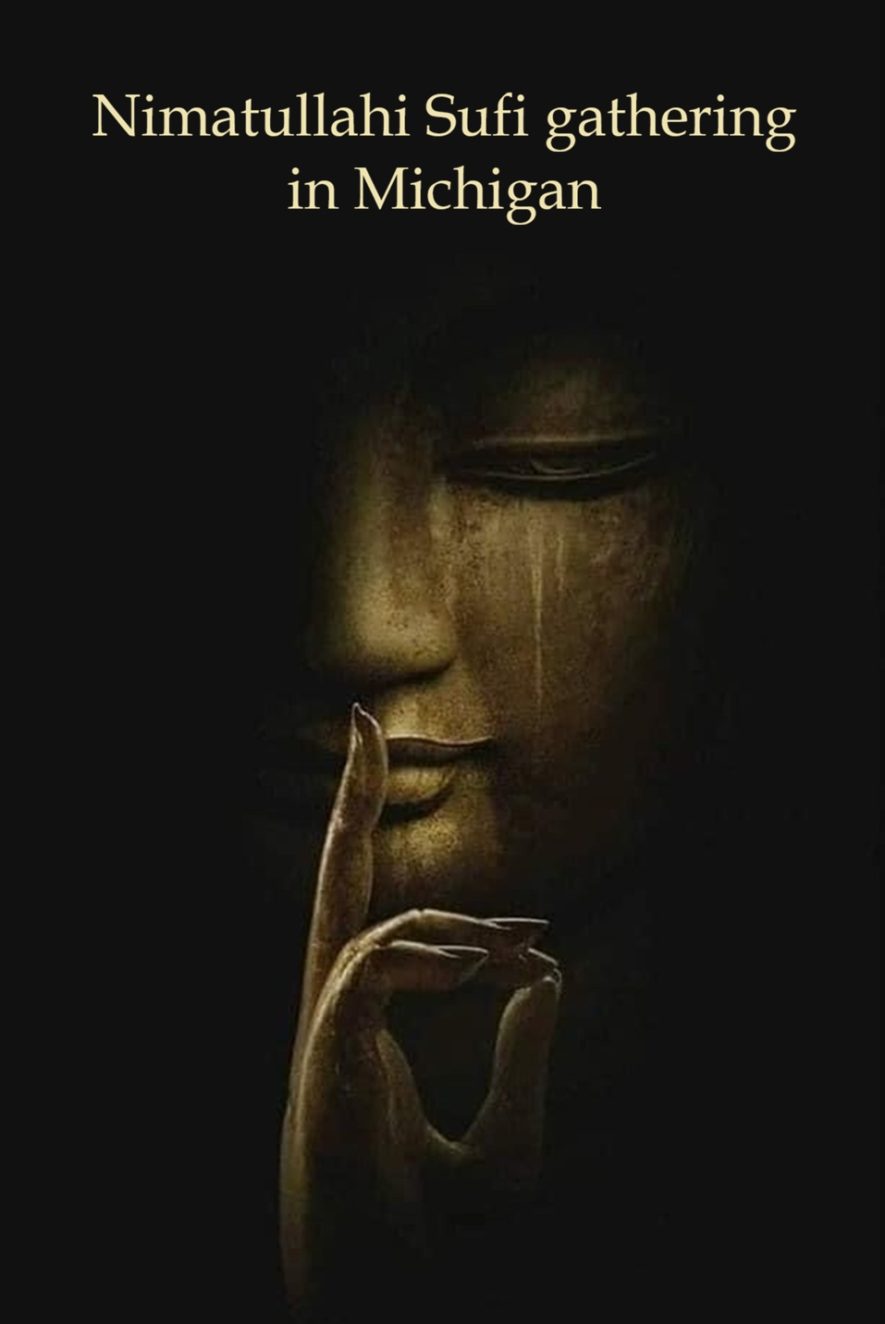
“I looked into the light until I became myself that light”
Strange miracles are ascribed to him, although he seems to have been critical of miracles: when the banks of the Tigris joined together to enable him to cross, he swore that he would cross only in a boat (as-Sarraj 1914, p. 325). However most famous is the story that he daringly addressed God to bring out a fish of a certain weight from the Tigris – and he caught the fish, a miracle that induced Jonayd to remark: “It would have been better if a snake would have surfaced to bite him.” (as-Sarraj 1914, p. 327). This story is perhaps exaggerated in order to stress the contrast between Nuri and the Baghdadian leader of whom one of his colleagues said: “If intellect had the shape of a man, it would be Jonayd.”
Given his – may we say ‘anti-intellectual’ – attitude, it seems perfectly natural that Nuri loved sama‘ for “The Sufi is one who listens to sama‘.” Again, his encounter with Jonayd in this connection is well known: when he tried to induce this colleague of his to participate in the whirling, Jonayd only replied with the Koranic verse: “You see the mountains and think them firm, but inside they are like passing clouds” (Koran 27: 90).
That is, the true ‘listener’ is moved only inside his heart, but does not show any traces of his ‘ecstasy’. For Nuri, on the other hand, ecstasy and music were part of his mystical life, and not in vain does Ruzbihan Baqli ask in his threnody on the Sufis (1965, p. 377): “Where is the singing (tarannom) of Nuri?” It fits this picture that Nuri’s death was caused by his running in full ecstasy into a freshly cut reedbed; he died from the wounds on his feet and legs.
His complete surrender to the divine Beloved, which was probably the basis of his extraordinary ecstatic states, seems to have caused ‘Ansari’s remark that “he was more worshipping (a’badu) than Jonayd” – although at times he followed the sobering advice of his colleague. Nuri was seen once weeping bitterly along with a sad old man – who was none else but Iblis – bemoaning his fate.
As Nuri claimed to be a lover (asheq), the Hanbalites declared him a heretic as the word ‘eshq was not permissible to express the relation between man and God in the Arabic language; but for Nuri the term mahabba (from the root that occurs in the Koran 5: 59) denoted a higher stage than ‘eshq, for the ‘asheq, he thought, is kept away, while “Love (mahabba) is to tear the veils and unveil the secrets” (Ruzbehan 1965, p. 100). Later Sufis would reverse the order.
Dangerous seemed his remark, “Deadly poison,” when he heard the mo’adhdhen’s call to prayer, while he answered a dog’s barking with “At Thy service” (Labbayka) (Ruzbehan 1965, p. 96) – with this seemingly impious exclamation he intended to blame a person who performed religious duties for money but understood from the dog’s mouth how every creature praises God. His paradoxical statements and actions were certainly not appreciated by many of his colleagues – he threw a considerable amount of money, which he had just received, into the Tigris instead of using it, as his friends advised him, for pious purposes; but he found even the thought of owning money for a certain time too distracting.
Kalabadhi mentions that Nuri wrote about mystical sciences with symbolic expressions (esharat) (1934, p. 13). But only about two decades ago P. Nwiya (1970 pp. 220 ft) discovered Nuri’s Maqamat al-qolub, a treatise which contains fascinating descriptions of the human heart, that house of God, which is inhabited by the king ‘Certitude’ who is aided by two viziers, ‘Fear’ and ‘Hope’. Such an allegorical interpretation of Koranic terms appears also in his comparison of the heart to a castle with seven ramparts – here he seems to prefigure St. Teresa’s Interior Castle, and Luce Lopez Baralt (1985, ch.4 & 1983) has (convincingly as it seems to me) shown his influences upon the great Spanish Carmelites, Santa Teresa de Avila and San Juan de la Cruz. A very interesting development in the history of Sufism is that the influence of Nuri’s thought was felt down into later times, especially throughout North Africa.
Nuri’s language, called by ‘Attar fine and elegant (latif zarif), is highly poetical and Solami asserts that “there was no better representative of the Sufi path nor anyone with more refined expressions” (Solami 1953, p. 156). Particularly beautiful is his image of the heart as a garden which is either fertilized or destroyed by the divine rain: the rain of grace or the rain of wrath. It is a garden in which laud and gratitude are the odoriferous herbs – images which certainly are echoed in the garden imagery which was to become such an important aspect of Persian mystical and profane poetry alike.
For a modem historian of religion, however, one aspect of Nuri’s thought is in particular attractive. That is how he describes, based on Koranic terms, the way from the external phenomena of religion to its innermost core. Those who have worked with Friedrich Heiler’s immense survey of phenomenology of religion, Wesen und Erscheinungsformen der Religion (Stuttgart 1961), know the German scholar’s attempt to lead his readers through four concentric rings of phenomena and external manifestations of religion into the heart of the heart, the most sacred, unknowable and fathomless Essence. More than a millennium earlier, the Baghdadian Sufi had developed the following stages of understanding:
Sadr, breast, is connected with eslam, according to sura 39: 22.
Qalb, heart, is connected with iman, based on sura 49: 7.
Fo’ad, inner heart, is the seat of ma’refa (intuitive knowledge) as sura 53: 11 indicates, and
Lobb, the innermost kernel of the heart, is connected with tawhid (the essential declaration that God is One), as Nuri understands from the Koran 3: 190.
This sequence perfectly corresponds to Heiler’s schema in which the outward manifestations of religions are seen first, their interiorization and their use as symbolic figures come next, while the intuitive knowledge shows itself in the different reactions of human to the Divine revelation. But the last step, absolute tawhid, is something that is realized only in the darkest cell of the heart where one may find the Divine, the One who cannot be grasped by the hands of intellect but only by faith and love.
It shows Nuri’s ingenuity that he was able to develop this detailed description of the inner journey by relying completely upon the Koranic words. We understand his biographers who called him a ‘truly faithful man’ (saheb al-wafa) and ‘the prince of the hearts’ (amir al-qolub). And it speaks for the deep understanding of Jonayd that he, for all the frictions that may have happened between him and Nuri, deplored his death with the words: “Half of Sufism is gone.”
Notes
1. Professor Vincent Cornell, Duke University, drew my attention to this fact, which I believe has been inadequately surveyed until now.
References
‘Attar, Farido’d-Din. (1905-7). Tadhkerat al-awliya, R.A. Nicholson (ed.), London: Leiden.
Abu No’aim al-Esfahani. (1932). Hilyat al-awliya’, Cairo. 10 vols.
‘Ansari, ‘Abdullah. (n.d.). Tabaqatas-sufiya. A.H. Habibi (ed.), Kabul, n.d.
Dennenghem, E. (1942). Vie des saints musulmans, Algiers.
Heiler, F. (1961). Wesen und Erscheinungsformen der Religion, Stuttgart.
Hojwiri, ‘Ali ebn ‘Othman. (1925). Kashf al-mahjub, V.A. Zukovsky (ed.), Leningrad, R.A. Nicholson trans., London. (1911).
Jami, ‘Abdo’r-Rahman. (1957). Nafahat al-ons, M. Tawhidipur (ed.), Tehran.
Kalabadhi, Abu Bakr Mohammad. (1934). Ketab at-ta’arrofle-madhab ahl at-tasawwof, A.J. Arberry (ed.), Cairo.
Lopez Baralt, L. (1985). Hueilas de’lslam en la literatura espanola, Madrid, (English trans. Leiden: Brill 1992).
__ (1985). Huellas de’lslamen la litteratura espanola. Madrid.
__ (July 1983) “De Nuri de Bagdad a Santa Teresa de Jesus: el simbolo de los siete castillos o moradas concentricas del alma”, Vuelta, no. 80.
Massignon, L. (1929). Receuil des textes. inedits concernant I’histoire de la mystique en pays d’Islam, Paris.
Nwiya, P. (1970). Exegese coranique et langage mystique, Beirut: Dar al-Mashreq.
Qoshayri, Abo’l-Qasem. (1912), Al-resalafi ‘elm at-tasawwof, Cairo.
Ruzbehan Baqli. (1965). Ketab sharh ash-shathiyat, H. Corbin (ed.), Paris-Teheran.
Sarraj, Abu Nasr al-. (1914). Ketab al-loma’ fet-tasawwof, R.A. Nicholson (ed.), London: Leiden.
Solami, Abu ‘Abdo’r-Rahman. (1953). Tahaqat as-sufiyya, Nural-Din Shariba (ed,), Cairo.
Sohrawardi, Abu Hafs. (1966). ‘Awaref al-ma’aref, Beirut.
 michigansufi.com